Challenge
Create a racing experience that supports multiple race formats, control schemes, AI competition, and mobile session pacing.
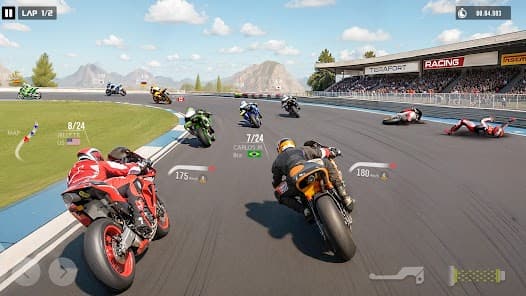
Racing
A high-speed motorcycle racing game featuring campaign challenges, knockout races, PVP-style AI competition, multiple control schemes, audio feedback, and bike progression systems.
Downloads
5M+
Modes
3+
Controls
3
Create a racing experience that supports multiple race formats, control schemes, AI competition, and mobile session pacing.
Organize race flow, control abstraction, garage systems, guidance UI, and audio feedback into reusable gameplay systems.
Shipped a large-scale racing title with millions of downloads and a broad mobile gameplay feature set.
Technical Case Study
Moto Max is presented as a production racing case study: multiple race modes, mobile control schemes, AI competition, garage progression, audio feedback, monetization, and performance-sensitive mobile delivery.
Unity Gameplay / Mobile Systems Engineer
A mobile racing stack focused on control abstraction, speed feedback, track navigation, and session readability.
Race formats required AI opponents, elimination pressure, and readable progress feedback.
Ads and purchases are treated as product systems that must not interrupt race readability.
High-level race flow from mode selection to input, race state, feedback, and rewards.
Race Mode
Control Adapter
Race State
AI Opponents
Audio/UI Feedback
Rewards / Garage
Performance Dashboard
Optimization is framed around stable racing feel, responsive input, and avoiding runtime spikes during short sessions.
Downloads
5M+
Modes
3+
Controls
3
Commercial SDKs are isolated from race logic so session flow remains testable.
Gameplay Session
Event Layer
Ads / IAP
Analytics
Revenue systems are surfaced at clean session boundaries.
Race Complete
Reward Resolution
Ad Opportunity
Garage Upgrade
Racing projects need input abstraction early because control modes affect every feedback loop.
Audio and UI feedback are not polish-only systems; they are part of race readability.
Monetization works best when it lives at clear session boundaries.
Moto Max Track Race is available as a compact, lazy-loaded mechanic lab connected to this case study.
Supported multi-mode racing structure with campaign, knockout, and competitive races.
Delivered mobile control options including tap/drag, tilt, and buttons.
Integrated bike garage progression, race guidance, minimap navigation, and audio feedback.